
Touring the many famous streets in London is a great way to get to know the city. The zebra crossing at Abbey Road, for example, is a piece of Beatles history. Wander along The Mall and you’re following in the footsteps of countless royal processions. Head to Portobello Road and, if you’re lucky, you may even spot Paddington Bear.
Ok, so that last one is less likely to happen but London’s famous streets tell so many stories and are a fun way to theme your trip.
I live in London with my three children and these 46 streets are ones that we’ve explored over the years. Some, like Savile Row, Carnaby Street and Oxford Street, are world-famous, while others such as Flask Walk in Hampstead of the rainbow-coloured houses of Chalcot Cresent, are less well known.
For each street, I’ve listed what it’s famous for, what not miss, the nearest station and some tips for visiting with kids. The streets are grouped by area, and there’s a map so you can link several in one easy day out.
Disclosure: This post may contain affiliate links. I have been or could be if you click on a link in this post compensated via a cash payment, gift or something else of value for writing this post. See our full disclosure policy for more details.

London’s famous streets at a glance
Table of Contents
Short on time? Here are all 46 streets in one place, grouped by area so you can see which ones sit close together.
| Street | Area | Famous for |
|---|---|---|
| Oxford Street | West End | Flagship shops, Christmas lights |
| Regent Street | West End | Hamleys, Christmas lights |
| Carnaby Street | Soho | Sixties fashion, boutiques |
| Shaftesbury Avenue | West End | Theatreland |
| Old Compton Street | Soho | LGBTQIA+ London |
| Greek Street and Frith Street | Soho | Bar Italia, Ronnie Scott’s |
| Gerrard Street | Chinatown | Chinese gates, bakeries |
| Denmark Street | West End | Music history, guitar shops |
| Cecil Court and Goodwin’s Court | Covent Garden | Old bookshops, Harry Potter |
| Neal’s Yard | Covent Garden | Colourful courtyard |
| Bond Street | Mayfair | World’s most expensive shopping street |
| Savile Row | Mayfair | Bespoke tailoring, Beatles rooftop |
| Burlington Arcade | Mayfair | Regency arcade, top-hatted Beadles |
| Piccadilly | St James’s | Piccadilly Circus, Fortnum & Mason |
| Jermyn Street | St James’s | Gentlemen’s outfitters |
| The Mall | Westminster | Royal processions |
| Whitehall | Westminster | Government, Horse Guards |
| Downing Street | Westminster | No. 10 |
| Strand | Covent Garden | The Savoy, Somerset House |
| Fleet Street | City | Newspapers, old pubs |
| Threadneedle Street | City | Bank of England |
| Lombard Street | City | Banking history, hanging signs |
| Leadenhall Market | City | Victorian market, Diagon Alley |
| Pudding Lane | City | Great Fire, The Monument |
| Marylebone High Street | Marylebone | Village shops, Daunt Books |
| Baker Street | Marylebone | Sherlock Holmes |
| Harley Street | Marylebone | Private medicine |
| Abbey Road | St John’s Wood | Beatles crossing |
| Brompton Road | Knightsbridge | Harrods |
| Exhibition Road | South Kensington | Museums |
| Kynance Mews | South Kensington | Cobbled mews, wisteria |
| King’s Road | Chelsea | Punk history, shopping |
| Bywater Street | Chelsea | Candy-coloured houses |
| Cheyne Walk | Chelsea | Blue plaques |
| Portobello Road | Notting Hill | Antiques market, Paddington |
| St Luke’s Mews | Notting Hill | Love Actually house |
| Westbourne Park Road | Notting Hill | Pastel houses |
| Camden High Street | Camden | Camden Market |
| Chalcot Crescent | Primrose Hill | Paddington’s house |
| Flask Walk | Hampstead | Village lane |
| Brick Lane | Spitalfields | Sunday market, curry |
| Columbia Road | Bethnal Green | Flower market |
| Broadway Market | Hackney | Saturday market |
| Leake Street | Waterloo | Graffiti tunnel |
| Clink Street | Bankside | Medieval prison, Golden Hinde |
| Electric Avenue | Brixton | Brixton Market |

Famous streets in the West End & Soho
If you want to tick a number of London’s famous streets off your list then head to the West End and Soho.
Oxford Street
Famous for: Europe’s busiest shopping street, flagship department stores and the Christmas lights
Running for about 1.5 miles from Marble Arch to Tottenham Court Road, Oxford Street is London’s most famous shopping street. It’s home to the UK’s big department stores, including Selfridges, John Lewis and Marks & Spencer, alongside almost every high-street brand you can think of.
The big news is that the street has finally going traffic-free. After decades of talk, the stretch between Orchard Street (by Selfridges) and Great Portland Street (just past Oxford Circus) closed to buses, taxis and cars on 26 October 2026. More seating, trees and space for events are planned over the coming year.
Oxford Street can get very busy, especially on weekends. When the crowds get too much, duck into St Christopher’s Place, a pretty pedestrian lane of cafes and restaurants just north of Bond Street station.
- Don’t miss: the Christmas lights, usually switched on in early November
- With kids: the new traffic-free section makes it far easier with a buggy. Selfridges has baby-changing facilities and is a good warm-up stop in winter.
- Best time: weekday mornings; avoid Saturday afternoons
- Nearest stations: Marble Arch, Bond Street, Oxford Circus, Tottenham Court Road
Regent Street
Famous for: grand curved architecture, Hamleys toy shop and London’s best-known Christmas lights
Designed by architect John Nash in the early 1800s and named after the Prince Regent (later George IV), Regent Street was London’s first planned street. Its sweeping curve of cream stone buildings runs from Oxford Circus down to Piccadilly Circus and is one of the city’s most elegant walks.
Today it’s lined with flagship stores, but the star for families is Hamleys, one of the world’s oldest toy shops, which has been on Regent Street since 1881. Personally, I find Hamleys too big and too busy but if you’ve got young kids then they will love it! Staff demonstrate toys on every floor, so allow plenty of time. I much prefer the near Liberty department store, which sits just off the street on Great Marlborough Street.
- Don’t miss: the view down the curve of Regent Street from just north of Piccadilly Circus
- With kids: Hamleys is a winner with young kids, but set a budget before you go in as it is expensive.
- Best time: weekday mornings; November and December for the lights
- Nearest stations: Oxford Circus, Piccadilly Circus
Shaftesbury Avenue
Famous for: the heart of London’s Theatreland
Built between 1877 and 1886, Shaftesbury Avenue was named after the 7th Earl of Shaftesbury, the Victorian reformer also commemorated by the famous statue at Piccadilly Circus. It runs from Piccadilly Circus to New Oxford Street and is lined with some of the West End’s best-known theatres, including the Lyric, Apollo, Gielgud, Sondheim, Palace and Shaftesbury.
Even if you’re not seeing a show, it’s worth walking at dusk when the theatre fronts light up.
- Don’t miss: the TKTS booth in nearby Leicester Square for same-day discounted tickets
- With kids: book a matinee of a family-friendly musical; many theatres offer booster seats
- Best time: early evening, when the marquees are lit
- Nearest stations: Piccadilly Circus, Leicester Square

Carnaby Street
Famous for: the birthplace of Swinging London and independent fashion
Carnaby Street was first built in the 1680s and took its name from Karnaby House, the first house on the street. Over the centuries it held a plague “pesthouse” and a market before becoming the epicentre of 1960s fashion. Mod boutiques drew in The Rolling Stones, The Who and The Kinks, and the street became shorthand for Swinging London.
Today it’s fully pedestrianised and part of a little network of 13 streets packed with independent boutiques, flagship fashion brands and places to eat. Kingly Court, a three-storey courtyard of restaurants just off Carnaby, is a great lunch stop.
- Don’t miss: the giant overhead installations, which change with the seasons and are especially fun at Christmas
- With kids: car-free and compact, so easy to explore
- Best time: any day; late afternoon for the lights
- Nearest station: Oxford Circus
Old Compton Street
Famous for: the heart of London’s LGBTQIA+ community
Running through the middle of Soho, Old Compton Street has been the centre of gay London for decades. Rainbow flags hang outside bars such as the Admiral Duncan and G-A-Y, and the street is a focal point for Pride in London celebrations each summer.
It’s also one of Soho’s great food streets. Look out for the Algerian Coffee Stores, which has been roasting and selling coffee here since 1887 and smells incredible from the pavement.
- Don’t miss: a coffee or a bag of beans from the Algerian Coffee Stores
- With kids: fine during the day for cafes and a wander; evenings are lively and bar-focused
- Best time: daytime, or during Pride
- Nearest stations: Leicester Square, Tottenham Court Road
Denmark Street
Famous for: “Tin Pan Alley”, London’s music street
Denmark Street was built in the 1680s and named after Prince George of Denmark, husband of Queen Anne. Several original buildings still survive. In the 1950s and 60s it was the centre of Britain’s music industry, home to music publishers, recording studios and the music papers NME and Melody Maker. It earned the nickname Tin Pan Alley after New York’s songwriting district.
The Rolling Stones and The Kinks recorded here, and the Sex Pistols lived and rehearsed at number 6. Today it’s best known for its guitar and music shops.
- Don’t miss: the blue plaque marking the street’s place in music history
- With kids: a fun quick stop for any child learning an instrument
- Best time: shop hours
- Nearest station: Tottenham Court Road
Cecil Court and Goodwin’s Court
Famous for: Victorian shopfronts and the Harry Potter connection
Tucked between Charing Cross Road and St Martin’s Lane, Cecil Court is a narrow pedestrian lane of antiquarian bookshops, map dealers and print sellers behind matching Victorian shopfronts. It’s often said to have inspired Diagon Alley. Mozart stayed here as a child in 1764.
A two-minute walk away, Goodwin’s Court is an even smaller alley of bow-fronted Georgian windows and old gas lamps that feels like stepping back 300 years.
- Don’t miss: browsing the old maps and children’s books in Cecil Court’s shops
- With kids: Harry Potter fans love it; pair it with a Covent Garden afternoon
- Best time: weekday afternoons, when the shops are open and it’s quiet
- Nearest station: Leicester Square

Neal’s Yard
Famous for: Covent Garden’s most colourful courtyard
This tiny courtyard is one of the brightest spots in London, with multicoloured shopfronts, window boxes and painted doors. It wasn’t always so cheerful, however, until the mid-1970s it was a dingy, rundown yard, until entrepreneur Nicholas Saunders opened a whole food shop that grew into a thriving community of ethical businesses.
Today it’s home to Neal’s Yard Remedies and a handful of cafes, and it’s a short walk from Seven Dials and the rest of Covent Garden.
- Don’t miss: the view from the courtyard entrance, the best angle for a photo
- With kids: a quick, colourful stop; combine with Covent Garden’s street performers
- Best time: early morning, before the crowds
- Nearest stations: Covent Garden, Leicester Square (often less crowded)
Greek Street and Frith Street
Famous for: Soho’s history, Bar Italia, Ronnie Scott’s and the first demonstration of television
These two parallel streets run north from Old Compton Street to Soho Square and are crammed with stories. On Frith Street, a blue plaque at number 22 marks where John Logie Baird first demonstrated television in 1926, and the young Mozart stayed at number 20 in 1764. Across the road, Bar Italia has served coffee since 1949, and Ronnie Scott’s is one of the world’s most famous jazz clubs.
On Greek Street, Maison Bertaux is London’s oldest patisserie and a gloriously old-fashioned spot for cake.
- Don’t miss: cake at Maison Bertaux, then a walk to Soho Square
- With kids: Soho Square’s garden is a good place for a run-around and a picnic
- Best time: late morning, before the lunch rush
- Nearest station: Tottenham Court Road
Gerrard Street
Famous for: the main street of London’s Chinatown
Gerrard Street was built between 1677 and 1685 and named after Charles Gerrard, the 1st Earl of Macclesfield, who used the land as a military training ground. London’s Chinese community began settling here in the 1950s, and by the late 1960s it was firmly established as Chinatown.
Today the street is framed by ornate Chinese gates and lined with restaurants, supermarkets and bakeries, with red lanterns strung overhead.
- Don’t miss: Lunar New Year, when Chinatown hosts lion dances and celebrations
- With kids: spotting the lanterns and gates is fun, and the bakeries are a hit; there are some great ice cream shops nearby too
- Best time: lunchtime, or Lunar New Year
- Nearest station: Leicester Square

Famous streets in Mayfair and St James’s
Just south of Oxford Street, Mayfair and St James’s are London at its most polished: luxury boutiques, centuries-old tailors, royal warrant holders and grand Regency arcades. All five streets here are within a 10-minute walk of each other, making an easy half-day loop from Bond Street to Piccadilly.
Bond Street
Famous for: the world’s most expensive shopping street
Bond Street is actually two streets. Old Bond Street was laid out in the 1680s by Sir Thomas Bond and runs north from Piccadilly; New Bond Street was added in the 1720s and continues up to Oxford Street. Together they’re London’s most glamorous shopping strip, home to Chanel, Louis Vuitton, Cartier, Hermès and Dior.
In November 2025, New Bond Street was named the world’s most expensive retail street for the first time, overtaking Milan’s Via Montenapoleone and New York’s Fifth Avenue.
It isn’t all about shopping, though. Sotheby’s auction house has been at 34–35 New Bond Street since 1917, and its pre-sale exhibitions are free to walk into.
- Don’t miss: the Allies sculpture of Winston Churchill and Franklin D. Roosevelt chatting on a bench, where Old and New Bond Street meet
- With kids: there’s a gap on the Allies bench just big enough for a child to sit between the two leaders; it makes a great photo
- Best time: weekdays, when it’s quieter
- Nearest stations: Bond Street, Green Park
Savile Row
Famous for: Bespoke tailoring and the Beatles’ last live performance
Tailors began moving to Savile Row in the late 18th century, and by the 1800s it had become the world’s most famous address for made-to-measure suits. In 1846 Henry Poole opened an entrance onto the street; the firm is credited with creating the dinner jacket.
Today you’ll find traditional names like Gieves & Hawkes at No. 1 and Huntsman, the inspiration for the Kingsman films, alongside modern tailors such as Ozwald Boateng. Peer into the basement windows and you can often see cutters at work.
On 30 January 1969, the Beatles played their famous rooftop concert on top of No. 3 Savile Row, then the headquarters of their Apple Corps company. It was their last public performance.
- Don’t miss: No. 3 Savile Row, scene of the rooftop concert
- With kids: a quick stop; Beatles fans can pair it with Abbey Road on the same day
- Best time: weekdays, when the tailors are working
- Nearest stations: Piccadilly Circus, Oxford Circus, Green Park
Burlington Arcade
Famous for: One of Britain’s first shopping arcades, patrolled by top-hatted Beadles
Opened in 1819, Burlington Arcade runs between Piccadilly and Burlington Gardens alongside the Royal Academy. It was built for Lord George Cavendish, reputedly to stop passers-by throwing rubbish into his garden. Today its covered walkway is lined with jewellers, watchmakers, cashmere shops and Ladurée macarons.
The arcade is still patrolled by Beadles in top hats and frock coats, Britain’s oldest private police force. Historically they enforced rules against whistling, singing, running and opening umbrellas.
- Don’t miss: spotting a Beadle in full uniform
- With kids: they’ll love the old “no running, no whistling” rules
- Best time: any time, but it’s especially pretty in the run-up to Christmas
- Nearest stations: Green Park, Piccadilly Circus
Piccadilly
Famous for: Piccadilly Circus, Fortnum & Mason and The Ritz
Piccadilly takes its name from the piccadill, a stiff lace collar fashionable in the early 1600s. A tailor who made his fortune selling them built a house nearby that Londoners nicknamed Piccadilly Hall, and the name stuck. The street now runs from Piccadilly Circus, with its giant illuminated screens, to Hyde Park Corner.
At the Circus, the winged statue everyone calls Eros is actually his brother Anteros, part of the Shaftesbury Memorial Fountain of 1893. Walk west and you pass Hatchards, London’s oldest bookshop, the Royal Academy in Burlington House, The Wolseley (one of my favourite restaurants in London) and The Ritz, with Green Park opposite.
Don’t skip Fortnum & Mason, the grand grocer founded in 1707 and famous for its tea and hampers. It’s also a lovely spot for afternoon tea.
- Don’t miss: Fortnum & Mason’s clock above the entrance, where figures of Mr Fortnum and Mr Mason appear on the hour
- With kids: Green Park is right there for a run-around after shopping
- Best time: Dusk, when the Piccadilly Circus screens light up
- Nearest stations: Piccadilly Circus, Green Park
Jermyn Street
Famous for: Shirtmakers, gentlemen’s outfitters and the statue of Beau Brummell
Laid out in the 1660s by Henry Jermyn, Earl of St Albans, Jermyn Street runs parallel to Piccadilly just one block south. For centuries this is where gentlemen came for shirts, shoes, hats and shaving kits before heading to their clubs in St James’s. Sir Isaac Newton once lived here.
It’s still lined with handsome old-world shops: shirtmakers such as Turnbull & Asser, Floris, a perfumer trading here since 1730, and the cheesemonger Paxton & Whitfield.
At the entrance to Piccadilly Arcade, look for the statue of Beau Brummell, the Regency style icon, inscribed with his advice that to be truly elegant you should not be noticed.
- Don’t miss: The Beau Brummell statue and a browse in Paxton & Whitfield
- With kids: The cheese shop is the highlight
- Best time: Shop hours on a weekday
- Nearest stations: Piccadilly Circus, Green Park

Famous streets in Westminster and royal London
For royal processions, mounted guards and a peak at British government you need to head to Westminster.
The Mall
Famous for: the red road to Buckingham Palace and the route of royal processions
The Mall started life in the 17th century as an alley for playing pall-mall, a croquet-like game. In the early 1900s it was redesigned as a grand ceremonial route, with Admiralty Arch at one end and the Victoria Memorial in front of Buckingham Palace at the other. The road is tinted red to give the effect of a giant red carpet leading to the palace.
It’s the stage for Britain’s biggest royal moments, from Trooping the Colour each June and state visits to the Platinum Jubilee in 2022 and the Coronation of King Charles III in 2023. It’s also the finish line of the London Marathon.
Don’t confuse it with Pall Mall, which runs parallel to the north and is lined with historic gentlemen’s clubs.
- Don’t miss: The view of Buckingham Palace from beneath Admiralty Arch
- With kids: The Mall closes to traffic on Sundays and bank holidays, so it’s perfect for scooters. Walk through St James’s Park alongside to see the pelicans, usually fed between 2.30 – 3pm
- Best time: Sunday mornings, or ceremonial days if you don’t mind crowds
- Nearest stations: Charing Cross, Green Park, St James’s Park
Whitehall
Famous for: Government buildings, the Horse Guards and the Cenotaph
Whitehall takes its name from the Palace of Whitehall, the main royal residence from the 1530s until a fire destroyed most of it in 1698. Only the Banqueting House survived, with its magnificent Rubens ceiling. King Charles I was executed outside it in 1649.
Today the street runs from Trafalgar Square to Parliament Square and is lined with government departments, including the Ministry of Defence and the Cabinet Office. Halfway along is the Cenotaph, the UK’s national war memorial, and nearby the bronze Memorial to the Women of World War II.
At Horse Guards, mounted troopers of the Household Cavalry stand sentry every day.
- Don’t miss: The Changing of the King’s Life Guard at Horse Guards, usually 11am (10am on Sundays)
- With kids: The mounted sentries are a highlight; the Household Cavalry Museum is right there too. The Churchill War Rooms are a short walk away for older kids.
- Best time: Mid-morning, for the guard change
- Nearest stations: Westminster, Charing Cross
Downing Street
Famous for: No. 10, home of the British Prime Minister
The first residential home was built on this iconic street in 1581 by Sir Thomas Knyvett, a Member of Parliament who arrested Guy Fawkes following the failed gunpowder plot. Today it is the office and London residence of the Prime Minster of Great Britain, as well as the Chancellor of the Exchequer.
Despite being one of the most famous roads in London however, you can’t actually walk along it; a gate and police guard stand at the entrance.
If you want to snap a photo, you can take a picture of the iconic black door from behind the railings. Alternatively, head to nearby 10 Adam Street on the Strand, which has a black door that looks remarkably similar. Incidentally, the door wasn’t always black, once upon a time it was green!
- Don’t miss: a peek through the gates at the most famous front door in Britain
- With kids: look out for Larry the cat, Chief Mouser to the Cabinet Office since 2011, sometimes seen on the doorstep
- Best time: any time; it’s a quick stop on the way down Whitehall
- Nearest station: Westminster
Strand
Famous for: The Savoy, Somerset House and centuries of London history
Strand comes from an Old English word meaning shore. The street once ran right along the bank of the Thames, before the Victoria Embankment was built. Note that it’s officially “Strand”, not “The Strand” (even Charles Dickens got that wrong). It runs from Trafalgar Square to Temple Bar, where it becomes Fleet Street.
Strand is full of stories. From 1773 to 1829, the Exeter Exchange on the north side held a menagerie of tigers, hyenas and even an elephant. Today it’s home to The Savoy, where Ian Fleming, creator of James Bond, was a regular, and to Simpson’s in the Strand, one of London’s most historic restaurants. Twinings has sold tea at No. 216 since 1706.
Further east, Somerset House hosts an ice rink in winter and dancing fountains in its courtyard in summer.
- Don’t miss: Savoy Court, the entrance to The Savoy and the only road in Britain where traffic drives on the right
- With kids: Somerset House’s courtyard fountains in summer or its ice rink in winter; St Clement Danes church is the “oranges and lemons” church of the nursery rhyme
- Best time: Winter for the ice rink, summer for the fountains
- Nearest stations: Charing Cross, Temple, Covent Garden

Famous streets in the City of London
The City is London’s oldest quarter, the square mile founded by the Romans nearly 2,000 years ago. Today it’s the financial district, but between the glass towers you’ll find medieval lanes, Victorian markets and the spot where the Great Fire of London began. Visit on a weekday when it’s buzzing, or on a weekend when it’s eerily quiet and perfect for photos (though many shops and cafes close).
Fleet Street
Famous for: The historic home of Britain’s newspapers
Named after the River Fleet, which now flows underground, Fleet Street runs from Temple Bar to Ludgate Circus. In 1702 Britain’s first daily newspaper, the Daily Courant, was published here, and by the 20th century almost every national paper had its offices on or near the street. “Fleet Street” is still shorthand for the British press, even though the last papers moved out in the 1980s.
Look for the glossy black Art Deco Daily Express building, and step into Ye Olde Cheshire Cheese, a warren of a pub rebuilt after the Great Fire and once a haunt of Charles Dickens and Samuel Johnson. It’s a fun historic place to stop for lunch although the food is not the best. Dr Johnson’s House, where he compiled his famous dictionary, is tucked away in nearby Gough Square.
- Don’t miss: St Bride’s Church, the journalists’ church, whose tiered spire is said to have inspired the shape of the traditional wedding cake
- With kids: Spot the dragon on top of the Temple Bar memorial, which marks the boundary of the City; older kids may enjoy St Bride’s crypt museum
- Best time: Weekdays
- Nearest stations: Temple, Blackfriars, Chancery Lane
Threadneedle Street
Famous for: The Bank of England, the “Old Lady of Threadneedle Street”
Threadneedle Street is home to the Bank of England, which has stood here since 1734. Its nickname, the Old Lady of Threadneedle Street, comes from a 1797 cartoon by James Gillray. The street’s name probably comes from the Merchant Taylors’ Company, whose hall has been here since the 14th century. Opposite the bank is the grand columned Royal Exchange, now home to upmarket shops and restaurants.
- Don’t miss: The free Bank of England Museum, where you can try to lift a real gold bar
- With kids: The gold bar challenge is a guaranteed hit, and the museum is free
- Best time: Weekdays, when the museum is open
- Nearest station: Bank
Lombard Street
Famous for: Centuries of banking history and its old hanging signs
Lombard Street takes its name from the bankers of Lombardy, in northern Italy, who settled here in the 13th century. It has been at the heart of London banking ever since, and Lloyd’s of London began life in Edward Lloyd’s coffee house here in 1691.
What makes the street special today is its painted hanging signs, a rare glimpse of how London’s streets once looked. Look up for the golden grasshopper (the crest of Tudor financier Sir Thomas Gresham), a cat with a fiddle and an anchor.
- Don’t miss: The golden grasshopper sign
- With kids: Turn it into a sign-spotting game
- Best time: Weekdays, in daylight
- Nearest station: Bank
Leadenhall Market
Famous for: A Victorian covered market and Harry Potter’s Diagon Alley
There has been a market on this spot since the 14th century, and before that it was the site of Roman London’s forum. The ornate covered market you see today was designed in 1881 by Sir Horace Jones, the architect of Tower Bridge, and its painted roof, cobbles and glass canopy are extraordinarily pretty.
Harry Potter fans will recognise it as Diagon Alley in Harry Potter and the Philosopher’s Stone. In Bull’s Head Passage, the blue door of an old optician’s shop stood in for the entrance to the Leaky Cauldron.
Right outside, Leadenhall Street is lined with some of the City’s most famous skyscrapers, including the Lloyd’s building and the “Cheesegrater”, with the Gherkin just behind.
- Don’t miss: The Leaky Cauldron door in Bull’s Head Passage
- With kids: A must for Harry Potter fans; pair it with Cecil Court in the West End
- Best time: Weekday lunchtimes for atmosphere, weekends for empty photos
- Nearest stations: Bank, Monument, Liverpool Street
Pudding Lane
Famous for: Where the Great Fire of London began in 1666
In the early hours of 2 September 1666, a fire broke out in Thomas Farriner’s bakery on Pudding Lane. Over four days it destroyed most of medieval London, including old St Paul’s Cathedral and more than 13,000 homes. A small plaque marks the spot.
A minute’s walk away on Fish Street Hill stands The Monument, designed by Sir Christopher Wren and Robert Hooke to commemorate the fire. It’s 202 feet tall, exactly the distance from its base to the site of the bakery. Climb to the top for some great views of London.
- Don’t miss: Climbing the 311 steps of The Monument for views across the City
- With kids: Climbers get a certificate at the bottom, and kids who’ve studied the Great Fire at school love seeing where it started
- Best time: Morning, before the queue builds
- Nearest station: Monument

Abbey Road, London
Famous streets in Marylebone and St John’s Wood
North of Oxford Street, Marylebone feels like a village in the middle of the city, with independent shops, pretty squares and a famous fictional detective. Hop one stop on the Jubilee line from Baker Street and you’re in St John’s Wood, home to the most famous zebra crossing in the world.
Marylebone High Street
Famous for: Village-style shopping and Daunt Books
Marylebone takes its name from St Mary’s church by the “bourne”, the Tyburn stream that once ran through the area. The high street has kept its village feel, with a winding layout and a mix of independent boutiques, delis, cafes and homeware shops rather than big chains.
Its star is Daunt Books, an Edwardian bookshop with long oak galleries and a stained-glass window. There’s a fantastic collection of travel books, all arranged by country
- Don’t miss: Daunt Books
- With kids: Paddington Street Gardens, just off the high street, has a playground; on Sundays the Marylebone Farmers’ Market is good for snacks. Daunt Books has a small but well curated children’s section.
- Best time: Weekday mornings, or Sunday for the market
- Nearest stations: Baker Street, Bond Street, Regent’s Park
Baker Street
Famous for: Sherlock Holmes
Laid out in the 18th century by builder William Baker, this busy road is famous worldwide as the address of Sir Arthur Conan Doyle’s detective, who lived at the fictional 221B Baker Street between 1881 and 1904. It was also immortalised by Gerry Rafferty’s sax-heavy 1978 hit.
The Sherlock Holmes Museum recreates the Victorian lodgings of Holmes and Dr Watson, complete with his violin, magnifying glass and deerstalker. Queues can be long, so book tickets online in advance.
Baker Street station opened in 1863 on the Metropolitan Railway, the world’s first underground line. Look for the Sherlock Holmes silhouettes on the platform tiles and the bronze statue of Holmes outside the Marylebone Road exit.
- Don’t miss: The Holmes statue and silhouette tiles at Baker Street station
- With kids: The museum is small and fun for young detectives; Regent’s Park, London Zoo and Madame Tussauds are all close by
- Best time: First thing, when the museum opens, otherwise be prepared to queue!
- Nearest station: Baker Street
Harley Street
Famous for: Private medicine and specialist doctors
Harley Street was developed in the 18th century on land owned by the Harley family, and doctors began arriving in the 1800s, drawn by its grand houses and good transport links. It has been the address for private medicine ever since.
Florence Nightingale worked here as superintendent of the Institution for the Care of Sick Gentlewomen in 1853, before leaving for the Crimean War. Film fans may know that Lionel Logue, the speech therapist to King George VI played by Geoffrey Rush in The King’s Speech, had his practice at No. 146.
- Don’t miss: The elegant Georgian doors and fanlights along the street
- With kids: There’s not a huge amount for kids here but you’re close to Marylebone High Street and Regent’s Park is also nearby
- Best time: Any time
- Nearest stations: Regent’s Park, Great Portland Street, Oxford Circus
Abbey Road
Famous for: The Beatles’ zebra crossing
The zebra crossing outside Abbey Road Studios is probably the most photographed crossing in the world. On 8 August 1969, photographer Iain Macmillan took the shot of John, Ringo, Paul and George striding across it for the cover of the Abbey Road album, in a shoot that lasted around ten minutes. Both the studios and the crossing are now Grade II listed.
The crossing is at the southern end of Abbey Road, at the junction with Grove End Road, and you’ll know you’re there by the crowds. The white wall outside the studios is covered in messages from fans.
- Don’t miss: The Abbey Road Studios live webcam, so friends at home can watch you cross
- With kids: While they’ll have fun recreating the album cover be aware that this is a busy road and cars get frustrated with the number of visitors attempting to halt traffic while they snap a photo!
- Best time: Early morning, before the crowds and traffic
- Nearest stations: St John’s Wood, Maida Vale

Famous streets in Knightsbridge, Kensington and Chelsea
This corner of west London combines world-class museums, the city’s most famous department store and some of its prettiest streets. It’s one of the best areas in London for families: the South Kensington museums are free, and Chelsea’s quieter streets are lovely for a stroll down to the river.
Brompton Road
Famous for: Harrods
Running through the heart of Knightsbridge, Brompton Road is London’s second great shopping street after Oxford Street. Its star is Harrods, which began as a small grocer’s shop on the site in 1849 and grew into the vast terracotta department store you see today. Its motto, Omnia Omnibus Ubique, means “all things for all people, everywhere”.
The tiled Food Halls are worth seeing even if you don’t buy anything. Harvey Nichols is around the corner where Knightsbridge meets Sloane Street, and at the western end of the road stands the grand Brompton Oratory.
- Don’t miss: The Harrods Food Halls
- With kids: Harrods’ toy department is a treat, and teens love Harvey Nichols (see our guide to London with teens)
- Best time: weekday mornings
- Nearest stations: Knightsbridge, South Kensington
Exhibition Road
Famous for: London’s great museums
After the Great Exhibition of 1851, the profits were used to buy land in South Kensington for museums, colleges and concert halls, an area nicknamed “Albertopolis” after Prince Albert. Exhibition Road runs through the middle of it. Along its length you’ll find the Victoria and Albert Museum, the Science Museum, the Natural History Museum on the corner with Cromwell Road, Imperial College and the Royal Geographical Society.
In 2011 the road was redesigned as a “shared space” without kerbs or barriers, where pedestrians, cyclists and cars mix freely. Speaking from experience, this only occasionally results in an angry cabbie tooting at you to get out of the way!
- Don’t miss: The V&A’s porcelain-tiled courtyard at its Exhibition Road entrance and the enormous Rotunda Chandelier by Dale Chihuly
- With kids: The three big museums are free and among the best in the world for children. On rainy days, use the pedestrian tunnel from South Kensington station.
- Best time: Weekday mornings during term time; arrive at opening
- Nearest station: South Kensington
King’s Road
Famous for: Swinging Sixties fashion, punk and Chelsea shopping
The King’s Road began as a private road for King Charles II and only opened to the public in 1830. In 1955 Mary Quant opened her boutique Bazaar here, and by the 1960s the King’s Road was at the heart of Swinging London; Quant is often credited with popularising the miniskirt.
In the 1970s it became the birthplace of punk. At 430 King’s Road, Vivienne Westwood and Malcolm McLaren opened Let It Rock in 1971, renaming it several times, including SEX, before it became Worlds End, still recognisable by its backwards-running clock.
Today it’s one of London’s best shopping streets, with the contemporary Saatchi Gallery at Duke of York Square. Each May, during Chelsea in Bloom, shopfronts are covered in elaborate floral displays.
- Don’t miss: The backwards clock at Worlds End with the 13 hour face
- With kids: Duke of York Square has a Saturday food market from 10am
- Best time: May, for Chelsea in Bloom; Saturday for the market
- Nearest station: Sloane Square
Bywater Street
Famous for: Candy-coloured houses and George Smiley
This little cul-de-sac just off the King’s Road is lined with terraced houses painted in pink, blue, yellow and green, making it one of the most photogenic streets in Chelsea.
Fans of John le Carré will know that 9 Bywater Street is the home of MI6 officer George Smiley in his spy novels. The house also appeared in the 2011 film of Tinker Tailor Soldier Spy, starring Gary Oldman and Benedict Cumberbatch.
- Don’t miss: the view from the King’s Road end
- With kids: a quick photo stop between shops
- Best time: morning light
- Nearest station: Sloane Square
Cheyne Walk
Famous for: Riverside houses and blue plaques
Cheyne Walk runs along the Thames in Chelsea and has been home to an extraordinary number of artists and writers. Look out for blue plaques to novelist George Eliot at No. 4, poet and painter Dante Gabriel Rossetti and poet Algernon Swinburne at No. 16, the painter James McNeill Whistler at No. 96, engineers Marc and Isambard Kingdom Brunel at No. 98, and writer Hilaire Belloc at No. 104. In the 1960s, members of the Rolling Stones also lived here.
Halfway along, Chelsea Old Church has a statue of Sir Thomas More outside, and just along from it the pastel-painted Albert Bridge is lit by thousands of bulbs at night.
- Don’t miss: Albert Bridge at dusk, when the lights come on
- With kids: Cross Albert Bridge to Battersea Park, which has a large playground and a children’s zoo; the Chelsea Physic Garden nearby is London’s oldest botanic garden
- Best time: A sunny afternoon, staying until dusk
- Nearest station: Sloane Square, then a 15-minute walk or a bus along the King’s Road
Famous streets in Notting Hill
With its pastel houses, antique shops and starring roles in some of the best-loved films set in London, Notting Hill is one of the city’s most photogenic neighbourhoods. All three streets here are within a 15-minute walk of each other, so they fit easily into a morning, ideally a Saturday for the market.
Portobello Road
Famous for: The Saturday antiques market and Paddington’s favourite shop
Portobello Road began as a country lane leading to Porto Bello Farm, named after Admiral Vernon’s capture of Porto Bello in Central America in 1739. Today it’s one of London’s most famous streets, lined with antique shops, cafes and colourful shopfronts.
On Saturdays the street hosts the Portobello Road Market, often described as the world’s largest antiques market, selling everything from silverware and vintage prints to clothes and street food. Film fans will recognise it from Notting Hill (1999) and from the Paddington films, where the Browns visit Mr Gruber’s antiques shop.
While you’re here, stop by the Electric Cinema, which opened in 1910 and is one of the oldest working cinemas in Britain.
- Don’t miss: The antiques arcades at the southern end, near Westbourne Grove
- With kids: Saturdays get very crowded, so go early and leave the buggy at home if you can; kids love hunting for Mr Gruber’s shop
- Best time: Saturday, before 10am
- Nearest stations: Notting Hill Gate (antiques end), Ladbroke Grove (northern end)
St Luke’s Mews
Famous for: The pink house from Love Actually
Despite its starring role in Love Actually, few visitors know about St Luke’s Mews. It’s the street where Mark turns up with his cue cards on Juliet’s doorstep, and the pink house is still there. The cobbled mews is lined with pastel-coloured houses, wrought-iron railings, wooden shutters and plenty of greenery, making it one of the prettiest streets in London and the perfect spot for a family photo.
- Don’t miss: The pink house from the cue-card scene
- With kids: Kids might find this a little boring, take a quick photo and move on.
- Best time: Morning
- Nearest stations: Westbourne Park, Ladbroke Grove
Westbourne Park Road
Famous for: Pastel houses and William’s flat in Notting Hill
Another of Notting Hill’s picture-perfect streets, Westbourne Park Road is lined with pastel-painted townhouses that regularly appear on social media. Film fans come to see No. 280, used as the flat William shares with Spike in Notting Hill. The door itself has changed since filming.
Get here early if you’re hoping for a clear shot, as the street is usually lined with parked cars.
- Don’t miss: The stretch of pastel facades near Portobello Road
- With kids: Combine with Portobello Road and St Luke’s Mews for a short film-locations walk
- Best time: Early morning, before the cars and crowds
- Nearest stations: Westbourne Park, Ladbroke Grove

Famous streets in North London
Head to north London for market buzz, rainbow terraces and village lanes. Camden and Primrose Hill sit side by side, while Hampstead is a short tube ride further north and pairs perfectly with a walk on the Heath.
Camden High Street
Famous for: Camden Market, alternative fashion and giant shopfront sculptures
Camden High Street is one of London’s most eclectic streets. Shopfronts are decorated with enormous 3D sculptures (giant boots, dragons and aeroplanes), and the shops sell everything from Doc Martens to vintage clothing and body piercings.
At the northern end is Camden Market, open seven days a week. It’s really a cluster of markets: Camden Lock beside the Regent’s Canal, the Stables Market in former horse stables, and Buck Street Market in colourful shipping containers. Come for second-hand records, independent fashion and street food from around the world.
Camden also has a proud music history, from punk at the Electric Ballroom to Amy Winehouse, whose bronze statue stands in the Stables Market.
- Don’t miss: A stroll along the Regent’s Canal at Camden Lock
- With kids: Teens love the market; younger children enjoy a waterbus ride along the canal from Camden Lock to London Zoo
- Best time: Weekday mornings; weekends are very crowded
- Nearest stations: Camden Town, Chalk Farm. Camden Town can be exit-only at busy weekend times, so plan to leave from Chalk Farm or Mornington Crescent.
Chalcot Crescent
Famous for: The Browns’ house in the Paddington films
If you love Paddington Bear (and let’s face it, who doesn’t?), you’ll recognise Chalcot Crescent immediately. This curved terrace of rainbow-coloured houses in Primrose Hill was used as the Browns’ home, fictional 32 Windsor Gardens, in the films. It’s one of the prettiest streets in London, just a few minutes from the shops and cafes of Regent’s Park Road.
- Don’t miss: The full curve of the crescent from its southern end
- With kids: Combine with a climb up Primrose Hill for one of the best free views of the London skyline; remember people live here, so keep it quick and quiet
- Best time: Any time; mornings are quietest
- Nearest station: Chalk Farm
Flask Walk
Famous for: Hampstead’s spa history and village charm
In the early 18th century, when clean water was hard to come by, Londoners travelled to Hampstead for its iron-rich spring water. The water was bottled and sold from a tavern on Flask Walk, which is how the street got its name. Today’s Flask pub was rebuilt in 1874. Now a charming pedestrian lane strung with fairy lights, Flask Walk is home to small independent shops selling antiques, pottery, flowers, plants and ice cream. At its eastern end, Burgh House is a free local museum in a Queen Anne house with a lovely garden cafe.
- Don’t miss: Burgh House and its cafe
- With kids: Continue on to Hampstead Heath for hearty walks and the view from Parliament Hill
- Best time: Weekend mornings, followed by a walk on the Heath
- Nearest station: Hampstead, the deepest station on the Underground (take the lift)

Famous streets in East London
East London is the place for markets, street art and independent shops. All three streets here come alive at the weekend: Columbia Road and Brick Lane on Sundays, Broadway Market on Saturdays. Columbia Road and Brick Lane are a 15-minute walk apart, so you can easily do both on the same Sunday.
Brick Lane
Famous for: The Sunday market, curry houses, bagels and street art
Brick Lane takes its name from the brick and tile makers who worked here in the 15th and 16th centuries. Since then it has been shaped by waves of immigration: French Huguenot silk weavers, Irish and Jewish communities and, from the 1970s, the Bangladeshi community, which is why the area is known as Banglatown and street signs are in English and Bengali.
On Sundays the street and the old Truman Brewery fill with market stalls selling vintage clothes, records, crafts and street food. Brick Lane is also one of the best places in the city for street art, with work by famous names on walls all around. This area also forms part of the Jack the Ripper tour, trailing Victorian London’s most infamous serial killer.
- Don’t miss: A salt beef bagel from Beigel Bake at the northern end, open 24 hours
- With kids: Sunday crowds are heavy, so a sling or carrier beats a buggy
- Best time: Sunday, late morning
- Nearest stations: Shoreditch High Street, Aldgate East, Liverpool Street
Columbia Road
Famous for: The Sunday flower market
Among London’s famous streets, Columbia Road is definitely one of my favourites. Located in Bethnal Green, this narrow Victorian street is famous for its weekly flower market: every Sunday it’s lined with buckets of kaleidoscopic blooms, plants and shrubs, and stallholders calling out their prices.
The other thing I love about Columbia Road is that almost every shop is independent, selling arts and crafts, plants, handmade stationery and more. Two of my favourites are the art gallery Nelly Duff and Lily Vanilli, just off the main street, which does a wonderful range of cakes.
- Don’t miss: The end of the market, around 2–3pm, when traders sell off what’s left at bargain prices
- With kids: It’s very tight with a buggy, so go early or bring a carrier
- Best time: Sunday, from 8am for the best blooms
- Nearest stations: Hoxton, Bethnal Green
Broadway Market
Famous for: The Saturday food market
Broadway Market, in Hackney, is very much the place to be today, but it wasn’t always the case. The street was once part of a drovers’ route bringing livestock into London. It had a busy street market for decades but fell on hard times in the 1970s and 80s, and was nearly demolished.
The local community fought to save it, and in 2004 the Saturday market was relaunched. Now it’s one of London’s best food markets, with street food, bakeries, coffee, cheese and fresh produce. During the week the street is lined with shops, cafes, bars and restaurants.
- Don’t miss: A picnic from the market eaten in London Fields at the northern end
- With kids: London Fields has a big playground and a heated outdoor lido; the Regent’s Canal towpath at the southern end is good for a stroll
- Best time: Saturday, before midday
- Nearest stations: London Fields, Cambridge Heath
Famous streets in South London
South of the river you’ll find London’s most colourful tunnel, a lane steeped in medieval crime and punishment, and the market street that inspired a chart-topping song. Leake Street and Clink Street are both on the South Bank and easy to combine with a riverside walk, while Electric Avenue is a short ride south on the Victoria line.
Leake Street
Famous for: London’s legal graffiti tunnel
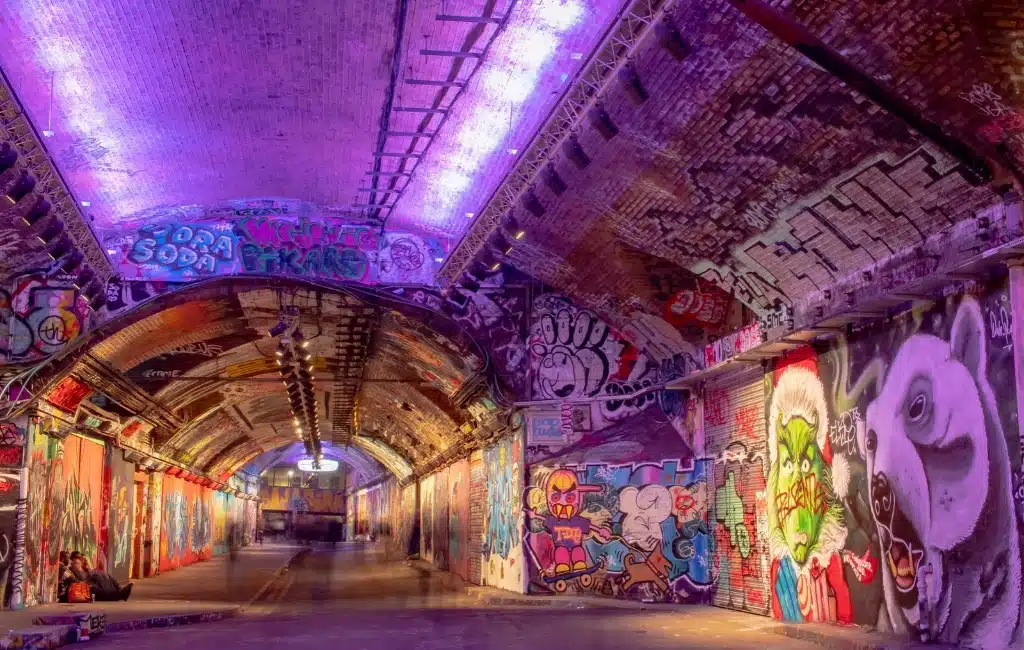
Running beneath the platforms of Waterloo station, Leake Street is a 300-metre tunnel where graffiti is legal, so its walls are repainted almost every day. Its fame dates from 2008, when Banksy organised the Cans Festival here, inviting street artists from around the world to cover the tunnel in art.
Today it’s officially the Leake Street Arches, home to bars, restaurants and performance spaces, but the ever-changing art is still the star. Come back a week later and it will look completely different. If you love it, our guide to the best street art in London has plenty more.
- Don’t miss: Watching artists at work, usually on weekend afternoons
- With kids: It’s free and endlessly colourful; older kids find it fascinating to see work being painted in real time (it can smell of spray paint, so don’t linger with babies)
- Best time: Weekend afternoons
- Nearest station: Waterloo
Clink Street
Famous for: The medieval prison that gave us the phrase “in the clink”
This narrow, shadowy lane runs along the river in Bankside, between Southwark Bridge and London Bridge. For centuries the area belonged to the Bishops of Winchester, and their prison, the Clink, operated here from the 12th century until it was burned down during the Gordon Riots of 1780. It was so notorious that “the clink” became slang for prison.
Today the Clink Prison Museum stands on the original site. A little further along are the ruins of Winchester Palace, with its striking 14th-century rose window, and a full-size replica of the Golden Hinde, the ship Sir Francis Drake sailed around the world in the 1570s.
- Don’t miss: The rose window of Winchester Palace
- With kids: The Golden Hinde is great for young sailors; the Clink Prison Museum suits older children who like gruesome history. Southwark Cathedral and Borough Market are a few minutes’ walk away.
- Best time: Weekday mornings, before the Borough Market crowds
- Nearest station: London Bridge
Electric Avenue, Brixton
Famous for: One of the first streets lit by electricity, and Eddy Grant’s hit song
One of the most famous streets in South London also has the coolest name. Built in the 1880s, Electric Avenue was one of the first shopping streets in the world to be lit by electricity, and its name comes from those lights.
It became famous worldwide in 1982, when Eddy Grant released his single of the same name. Contrary to popular belief, the song is less about the street itself and more about the tensions in Brixton around the 1981 riots.
Today Electric Avenue is the gateway to Brixton Market, with stalls selling Caribbean, African and Latin American produce, and to the covered arcades of Brixton Village and Market Row, packed with places to eat.
- Don’t miss: Lunch in Brixton Village
- With kids: The market is colourful and fun with some delicious global street food too; continue to Windrush Square and the Black Cultural Archives, or Brockwell Park for its playground and lido
- Best time: Market days, late morning
- Nearest station: Brixton
Famous streets in London: FAQs
What is the most famous street in London?
Oxford Street is London’s most famous and most visited street, and Europe’s busiest shopping street. Abbey Road, thanks to the Beatles’ zebra crossing, and Downing Street, home of the Prime Minister, are just as recognisable around the world.
What is the most expensive street in London?
For shopping, it’s New Bond Street in Mayfair. In November 2025 it was named the world’s most expensive retail street, overtaking Milan’s Via Montenapoleone and New York’s Fifth Avenue.
Is Oxford Street pedestrianised?
Partly. Since 26 October 2026, the stretch between Orchard Street (by Selfridges) and Great Portland Street (just past Oxford Circus) has been closed to buses, taxis, cars and bikes. More seating, trees and event space are being added, with a longer-term design due from spring 2027.
Can you walk down Downing Street?
No. Downing Street has been closed to the public by security gates since 1989. You can still see the famous black door of No. 10 through the railings on Whitehall, and nearby 10 Adam Street, off the Strand, has a lookalike door you can photograph up close.
Where is the Abbey Road zebra crossing?
The crossing is outside Abbey Road Studios in St John’s Wood, at the junction of Abbey Road and Grove End Road. The nearest tube station is St John’s Wood, about a 10-minute walk away. It’s free to visit, but it’s a busy road, so take care when recreating the album cover.
Which famous London streets are on the Monopoly board?
Many of the streets in this guide appear on the UK Monopoly board, including Whitehall, Strand, Fleet Street, Piccadilly, Regent Street, Oxford Street and Bond Street. Park Lane and Mayfair are the most expensive squares, and Old Kent Road the cheapest.
Which London streets appear in Harry Potter?
Leadenhall Market in the City was used as Diagon Alley in Harry Potter and the Philosopher’s Stone, and a blue door in Bull’s Head Passage was the entrance to the Leaky Cauldron. Cecil Court, off Charing Cross Road, is often said to have inspired Diagon Alley.
How many of London’s famous streets can you see in one day?
Quite a few, because many sit close together. In a single day on foot you can easily cover Oxford Street, Regent Street, Carnaby Street, Savile Row, Piccadilly, Jermyn Street, The Mall, Whitehall and Downing Street, finishing on the Strand.

